Wednesday, 19 October 2011

Deep mining with Déjà Vu X2

"Déjà Vu" is a translation memory program created by the company Atril. It stores my previous translation work in databases and uses these databases to help me in every new translation job. There are three types of database. The "translation memory" (TM) contains the sentences in my source language together with my translations of these sentences. My main TM has about 385,000 sentence pairs in my two languages (German and English), so it is effectively an archive of all the work I have done since I started using Déjà Vu in late 1999. The "termbase" (TB) has terminology items which I have entered. My main TB has about 54,500 terminology pairs. In addition, there is a "lexicon" for each project, which is a place to put proper nouns, client-specific terminology etc. When I work on a new translation project, the program calls on these databases to offer as much help as possible. Sometimes this enables me to work much faster on a project. But usually I have projects with long and complicated sentences, especially contracts, so the speed gains are usually more modest. The main benefit of Déjà Vu for me is as a tool for quality which enables me to be more consistent in my work.

Over the last 12 years I have seen three generations of the program. The first version was known by the abbreviation "DV3". The next generation, DVX, was released in May 2003. The latest version is DVX2, which was released in May 2011.

Each new version has new features. A list of new features in DVX2 can be found here. One new feature which has puzzled many people is "DeepMiner". The theory is that it uses both the TM and the terminology databases to retrieve even more material. But how does it work in practice? There is a training video which uses an extremely simple example to show cross-analysis between the sentences "I have a brown dog" and "I have a black dog" when translating them into French.

So far so good. In practice, however, my sentences are never as simple as this example, and the size of my databases means that DeepMiner has to work much harder. As a result, using DeepMiner on a largish project with big databases can be very slow. And in my experience, DeepMiner is sometimes not helpful because it tries to be too clever and reconstruct the solution from similar sentences in the TM, and in the process it may overlook what I have in my termbase and lexicon. Thankfully, it is easy to switch the DeepMiner function on or off.

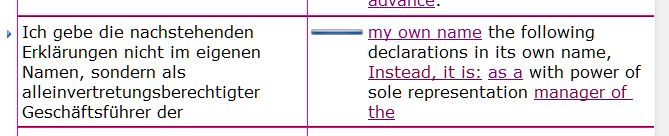
So how helpful is this new function? To illustrate this, let's look at one example sentence from a complicated German land purchase and partitioning contract in two alternative versions: with and without DeepMiner:

My translation:
I make the following declarations not in my own name, but as a manager with power of sole representation of ...

Looking at the first half of the sentence, where do the phrases "my own name" and "the following declarations" come from in the example with DeepMiner? They are not in the terminology hits for this segment, and there is no whole sentence match. But the TM has many matches containing "die nachstehenden Erklärungen" and the translation "the following declarations" (although "nachstehend" on its own is only in the TB as "hereinafter"). The first three words "my own name" seem strange at first sight. Somehow, DeepMiner seems to have found a correlation between the words "ich ... im eigenen Namen" and the English "my own name", in spite of the fact that the TB entries which use "im eigenen Namen" only offer the English "its own name" and "his own name".

At least in this example, DeepMiner offers solutions which go beyond the conventional assembly and pretranslation routines in the previous version of DVX. In my experience, it is still a matter of trial and error - sometimes it finds surprisingly good suggestions, but sometimes it is not really helpful. One possible workflow to get the best of both worlds is to "Pretranslate" the whole file with DeepMiner activated and then, if the solution is not helpful, to "Assemble" the individual sentence without DeepMiner. To do this, the settings for Pretranslate are:

And the settings for Assemble (under Tools>Options>General) are:

I am still experimenting to find out how DeepMiner can be used to best advantage, so perhaps I will be able to add more insights at a later date. Before too long (hopefully) I will comment on some of the other features of DVX2 such as AutoWrite, the information design options in the variable grid layout etc.

Monday, 4 July 2011

Translating is believing

There is something special about language. And we, as translators, are in a special position to appreciate it. We have the incredible privilege of using the raw material of language - words, rhythm, imagery - to earn our daily bread.

Part of this privilege is that we see the beauty, uniqueness and variety of two (or more) different languages. This is not only found in literature - we can experience the special charm of our languages even in everyday speech. And every language has its own local variants. I have just experienced a couple of weeks in the west of the USA, where English is the same language as my native British, and yet somehow different. In my adopted language German there are intriguing differences between “High German”, the “Berlinerisch” dialect that some speak in the city where I live and other regional variants such as Bavarian, Swabian, Sächsisch, Mainzerisch and many more.

Fascination at every turn! And this leads me to ask where all of this comes from.

Language is wonderfully creative. Whenever I am reminded of the special quality of our “raw material”, it makes me doubly grateful to the Creator who made it all possible. Working with language means handling a miracle. For me, translation is a celebration of my faith in the God who gave us language.

Here, I am not trying to build a logical and irresistible argument for belief. I am not trying to prove anything to those who do not believe. I am simply giving expression to my own sense of wonder. This is my reason for the title of this article: “Translating is believing”.

Wednesday, 22 June 2011

The voice in the restroom

It was in a men's restroom (i.e. a toilet) on a rest area (a lay-by or service station) next to a freeway (a dual carriageway) in California. Suddenly, a woman's voice rings out loud and clear, speaking in a language that hardly anyone can understand. She says “Dem Strassenverlauf sechzig Kilometer folgen!” Just imagine how the heads turn!
Oops, I have my GPS sat-nav in my shirt pocket and forgot to turn it off when I got out of the car. The lady in the electronic box obviously thinks I am still driving and wants me to continue for sixty kilometres (or is it kilometers?) straight ahead.
Yes, folks, I am taking a two week break. I am in jet lag country, a land where I have to make many adjustments. The most obvious is the time difference. When we touched down at San Francisco International, it was half past ten on Sunday evening - but in Berlin, which we had left just a few hours previously, it was already 7:30 on Monday morning. Nine hours! And in a couple of weeks I will have to make the same leap in the opposite direction!
Another adjustment is the language. When I left my home in Berlin, I thought I was going on holiday. But now I find that I am on vacation, and I am faced with a number of language mysteries. The first is the coinage. Exactly what value do nickels, dimes and quarters have? Quarters are explained on the coin (quarter dollar), but the dime coin only confesses to being a dime, without any numerical value, and the nickel (as far as I can make out), is just a slang term for one of those tiny coins with its value printed in words much too small to read in a hurry. Oh for those days of my youth when my currency of everyday use was denoted by easy-to-understand concepts such as tanner, copper, bob, quid and the good old threepenny bit.
So although I can hear and speak my native language here, some of the words are rather “foreign” to me. The water to wash my hands comes out of a faucet instead of a tap. A covered shopping arcade is a “mall”, which rhymes with “fall”. And the word “fall” itself has a couple of extra meanings. In the singular it is the season after summer, and in the plural it denotes a waterfall - as in the “Middle Falls”, which we saw yesterday. Very impressive, but it was only one “falls”. And the word “lever” rhymes with “clever” instead of “beaver”.
Power sockets have their own very distinct character here, too. A cute little face, but with a square nose and square eyes like a cartoon character. Perhaps the square eyes come from watching so much TV.
And even the seasons are different here. On the longest day in June, a day so hot that even the air conditioning in an American car is struggling to keep me moderately cool, a road though the mountains has to be closed because of deep snow. If I really tried to hitch a ride (or lift) there, I would have to wait a few weeks. Does anyone know what mountain this is? Anyone care to guess in the comments? Then I will let the cat out of the bag. Hey, that's probably a Britishism, I wonder what the locals here would say.
(Later addition:) OK, time to spill the beans. The mountain is Mount Shasta, which rises to over 4,000 meters/metres. The "Road closed" sign is at about 2,000 metres on a road that leads past the mountain, and even when open it probably does not go much higher than this car park.
We are staying in Redding, about 80 miles further south, and attending a Christian conference at a church here. There is a good view of Mount Shasta from the church grounds (sorry: campus).

Friday, 10 June 2011

Babel in reverse?


In many countries around the world, this Sunday (12th June) is celebrated as Whit Sunday, and in some places Whit Monday is a public holiday - and a day off work for employees in many business companies. So it is an important date in the calendar. But if you ask what is actually being celebrated, most people, even in churches, are lost for words.
The first "Whitsun" was the very opposite. In a spontaneous gathering in first century Jerusalem, which was rather like a "flash mob", the confusion of languages which originated in Babel was overcome, at least for a short time. The story can be found in the New Testament (Acts of the Apostles, chapter 2):
They (the believers) were all filled with the Holy Spirit and began to talk in other languages, as the Spirit enabled them to speak. There were Jews living in Jerusalem, religious men who had come from every country of the world. When they heard this noise, a large crowd gathered. They were all excited, because each one of them heard the believers speaking in his own language. In amazement and wonder they exclaimed: "[...] All of us hear them speaking in our own languages about the great things that God has done!" Amazed and confused, they kept asking each other, "What does this mean?" (Acts 2:4-7, 11-12, Good News Bible)

What happened?
The city was full for a Jewish religious festival. The visitors and residents were ethnic Jews and were there for the festivities, which were conducted in Hebrew. Some of the people in the city actually lived in other countries and spoke other languages. The text gives a list of the languages represented, citing 14 or 15 different languages or language groups. But almost all of the speakers of these languages probably spoke Hebrew too, at least as a second language, because they obviously kept their ties with their ethnic home country, otherwise they would not have come to Jerusalem for the festival. And although they had different primary languages, they were still able to communicate with each other about the surprising events they were witnessing. This discussion, and the public speech by the Apostle Peter which followed, were presumably in Hebrew - and without any miraculous translation.

Was it really necessary?
The New Testament narrative portrays a language miracle, a reversal of the events at Babel which I commented on in an earlier blog post. But what was the point of this miracle?
●   It apparently did not happen during Peter's subsequent speech. The message about Jesus was evidently not conveyed by a language miracle, it was conveyed in Hebrew, and the listeners were able to understand and respond.
●   The people in the crowd were able to discuss the events among themselves without a language miracle.
●    The language miracle came at the start of the flash meeting, when it seems all of the believers were speaking at the same time. They must have been pretty loud, because it was the noise that attracted the crowd. It was only after the crowd had gathered that some of the listeners started saying, "Hey, that's my home language! How come you speak that language?"
 ●   We are not told in detail what was communicated by the miracle. We are told that the believers spoke of "the great things that God has done", but the detailed explanation was then given by Peter in a separate speech, presumably in Hebrew.
So although this event was a language miracle and had an influence on the way the message was received by the crowd, its real significance seems to lie elsewhere - not just in getting the message across.
And this brings me to another observation on the way language works.

The credibility gap
This blog post is difficult for some to believe. When I speak about a language miracle, I am convinced that it is possible. To me, this is a logical consequence of my faith in God. Perhaps some of my readers do not agree. In itself, that is not a problem. I am sure that we are mature enough to differ without any hard feelings. But our differences also have a linguistic element.
When I speak about my faith, listeners who do not believe in God can understand the words, but they may find it difficult to grasp what I am talking about. Sometimes it even seems as if we can't communicate at all.
Similarly, if you tell me about the joys of deep sea diving, some listeners may feel the exciting ripple of water on the skin and the joy of seeing the many life forms that live under water. But the only message I receive is the claustrophobia of the diving mask and the fear of getting water in my nose.
Our experience of the world influences the way we "understand" language, and differences in our subjective make-up can interfere with our objective ability to comprehend what another person is saying. So when I talk about my belief in God, more than just linguistic ability is necessary to "receive" the message.

The view from the inside
As a linguist, I am curious about the phenomenon of "speaking in tongues" (which is the jargon term for speaking in unknown languages). This phenomenon still happens today, and sometimes I hear such unknown languages used by others, sometimes I use this phenomenon myself as a style of prayer. I do not know whether my own prayers in "tongues" are ever in an identifiable language. I have heard reports of such prayers being identified as specific languages (including a report from someone close to me), but usually I simply do not know. And if I try to analyse the sounds made, this somehow detaches me from the prayer. I can pray in "tongues" or I can analyse - but not both at once. And it is always my choice - this form of prayer is not compulsive or involuntary.

Language as a mystery
I regard language itself as a mystery and a miracle. This post simply explores one facet of this mystery. There is much more that could be said - so feel free to add other aspects in the comments

Wednesday, 4 May 2011

The specialist opportunity

As a translator it is important to develop expertise in special subjects. But how can we do this? One possibility is to use the opportunities which arise in the course of our work, and then develop them. In my first few years in the translation business, especially in my work for various agencies, I came in contact with a number of subject areas. Some of them were isolated encounters – the topic did not really arouse my interest and I did not develop it. Others became a springboard into a genuine specialism. It has taken time, effort and money to develop these special areas, but I believe that it is worthwhile.

I would like to begin with a little chart to show ten possible stages in this process:


Some special areas are well defined, and there are clearly targeted courses to help us develop our knowledge.  Other specialist areas are less formally structured, and greater resourcefulness is required to develop our skills and find information.
Let me explain this by three examples with anecdotes from my own experience:
1. Technology (the partial specialist)
2. Architecture/building/property (the self-taught specialist)
3. Law (informal learning and training courses)

1. Technology (the partial specialist)
The first translation agency I worked for specialised in technical subjects. I worked on a freelance basis, but usually in their offices. On my first day I was nervous about the subject area and expected that I would be far too slow because I was new to the subject. However, in my very first job there (about a conveyor belt for transporting coal) I found that I could work quickly and well, and I even found a logical mistake in the source text which the end client then corrected. Within a couple of weeks I gained a reputation for speed and competence.
Encouraged by this success, I then took and passed the State Translation Examination in Berlin with Technology as my special subject.  But "Technology" covers many individual disciplines, and I didn't see any realistic way to develop my skills and knowledge in this wide-ranging field. So although I started well and still occasionally do jobs in technical subjects, I only regard myself as a "partial" specialist.

2. Architecture/building/property (the self-taught specialist)
I started my freelance translating career in 1991 in the most exciting city in the world - the reunited city of Berlin. I had been here long enough to know about the Berlin Wall and the exciting days of political and social upheaval. When the building boom in Berlin began in the early 1990s, this led to a number of translation jobs. I became increasingly familiar with architectural and building texts and translated a number of books on the subject. I started to collect reference works in both languages, especially in my native British English. Then came the opportunity to work on a bilingual dictionary of building (Cornelsen Wörterbuch Bau), which meant that I had to research even more monolingual texts. I even attended building trade fairs (one in Berlin, one in Birmingham/UK) and collected brochures and other information. I subscribed to a couple of e-mail forums where practitioners talk about their trade, exchange references, argue with each other – and never ever worry about other languages or how to translate anything that they say.
This has led to work in a number of areas and text types: the lyrical prose used by architects and journalists to describe works of architecture, technical descriptions of building processes and materials, texts on urban planning, road and railway construction, rehabilitation of polluted sites, heritage conservation, property advertising materials, a couple of interpreting jobs in construction planning meetings, contract translation and interpreting jobs related to property purchases etc.
I have never heard of any structured courses or teaching materials directed at translators in these subject areas. The translator can benefit from courses in related areas (e.g. Law), but on the whole, this subject area is a field for the self-taught specialist.

3. Law (informal learning and training courses)
Here, too, I started from small beginnings and developed specialist knowledge and skills over a number of years. I had some previous experience with legal texts before I began translating as a career, but no formal background. When I passed the State Translation Examination in Berlin, I became eligible to work as a court-approved translator and interpreter. This led to my first experience of a formal training session in the area – a seminar held by the BDÜ which explained the basic principles of working for the courts.
After several years of informal learning and many successful translation jobs, I then heard of a number of courses on legal translation at the City University in London, and I have attended a total of five such courses, ranging in length from one day to four days. Some of the people who attended these courses worked hard to obtain a degree (Diploma or M.A. in Legal Translation), others (like me) just attended them for the learning experience as CPD courses ("Continuing Professional Development"). Courses like this are not cheap – the course fee for each course comes to a few hundred euros, plus the cost of transport to London and accommodation. But this investment is important if we take specialisation in our translation work seriously.

Over to you, dear reader. Where have you been through similar steps to become a specialist? What other possibilities have you identified? Have you found this development easy or difficult?

Monday, 7 March 2011

The legacy specialist

How can we specialise as translators? Perhaps you entered translating on the strength of your language skills alone, and you have gradually realised that you need to decide what subjects to focus on. Perhaps you have done a translation course at university, but the special subjects covered in the course did not provide enough depth to make you into a real specialist.

So where do you go from here?
The first step is to take stock. What do you already have in your favour? What skills, hobbies and interests do you have outside your work as a translator? What holiday jobs did you do as a student? Have you worked in other careers which gave you an insider's perspective in specific fields? Perhaps you can develop such areas into a real specialist subject.

For example, if you have been involved in a technical hobby (e.g. amateur radio, PA systems in a theatre or church, car maintenance, house repairs, computer software or hardware, computer gaming), this may give you a good background. If you understand the concepts used in these subject fields and the jargon in at least one of your languages, you can build on this. And your familiarity with the field will help you to advertise your services, too.

This principle could also apply if you have previous background in banking, investments, law, medicine, sports, entertainment, publishing, politics or a host of other areas. It is worth examining them and considering what potential they may offer. If you identify an area which could be useful in your translating career, the next step is to explore how you can develop this specialism, e.g. by collecting reading material in the area in all of your languages, attending courses, finding information and discussion forums on the Internet.

My own biography contains various examples of such subject fields. In some cases, I have never got any benefit from them and it never occurred to me to look for work. Other fields have brought one or two jobs but had no lasting effect on my career. And one or two have blossomed into special areas in which I now have a wide range of knowledge and experience.

One of the "no shows" is the area of sports and games. In my school and university days I had a reasonable general knowledge and limited skills in sports such as football (soccer), cricket and tennis, and a good knowledge and moderate skills in chess. But the nearest I have come to working in these areas were a couple of legal texts which happened to involve footballers, but without any reference to the sporting action.

I have not done much translation related to school education, although I did a one-year university course in Education and spent several years working “at the chalk face” in both Germany and England. Apart from official translations of a few school leaving certificates (mainly German “Abitur” reports), this area has brought hardly any work. The other subject area in which I once worked in-house, publishing, has been slightly more productive. I have occasionally worked on subjects that I learned about there such as layout and typesetting. I have benefited from my in-house understanding of employee organisations and work safety procedures. And my experience in a publishing house helped me to get a number of book translating jobs. But my work in the publishing house also introduced me to an area which is now a major specialism. I became involved in copyright work, mainly to obtain publishing rights for material drawn from other sources. This meant that I needed to read the German Copyright Act and explain some of its provisions in correspondence with offices in England and other English-speaking countries. This gave me a good background several years later when I started to translate legal texts. I then had to develop this subject area step by step to reach the level I am at today. The steps in this development were extremely important, but they are another story for another blog entry.

Another area in which I already had considerable background was the Christian religion. I had been actively involved in a variety of Christian churches in both Germany and England, (and still am). Even before I started translating as a career I had often acted as an interpreter for sermons in local churches. In fact, this area was my natural first step as a freelance translator, and in the first three or four years much of my work was in the field of Christian book publishing (mainly translating from my mother tongue of English to my non-native German, but that, too, is another story). I even worked on a bilingual dictionary in this area. This dictionary has been out of print for many years now, but a revised version of the German-English section is still available on my website. However, over the years I have done less and less work in this area, and distinctly Christian texts are now few and far between.

A very mixed career biography. Some potential subject areas never got off the ground (chess, cricket, football). Others seemed promising but only occasionally brought in work (education). One area gave me a solid bilingual background which helped me to get started, but has gradually declined in importance over the years (Christian religion). Another area which once took up only a small part of my time has gradually developed into a major specialism (law). And other specialist areas only developed after I started working as a freelance translator 20 years ago.

Dear fellow translators, how has your career drawn on the knowledge and experience you had before you started translating for a living? Did your legacy of experience help you, or did you need to develop completely new skills?

Monday, 31 January 2011

Tinker, tailor, translator?

Tinker, tailor,
Soldier, sailor,
Gentleman, apothecary,
Ploughboy, thief

This old children's rhyme gives us a short list of possible careers or walks in life. If we transpose this to the world of translation, we could say that it gives us a list of special subjects. I may be an expert in the language of the “tinker”, who once roamed the streets collecting old iron and repairing household appliances. But I may be clueless when faced with the language of the soldier or sailor. And the language of the “apothecary” (pharmacist) or “ploughboy” require completely different sets of specialist knowledge.

This short list of just eight (8) specialist areas is extremely modest. By comparison, the list of subjects in the directory search offered by the German Association of Interpreters and Translators (BDÜ) at www.bdue.de has over 200 entries, and the list of specific fields in the KudoZ terminology search function at the website www.proz.com offers about 170.

Should a translator try to cover all of these subject areas? Should we flit like butterflies from insurance to philosophy to hydraulics to social studies to beekeeping? Should we offer translations in metalworking, politics, psychology, accounting, horticulture, contracts, marketing, building, veterinary medicine, geology, automotive engineering, dentistry, labour relations, genetics, visual arts, business management, computer gaming, terms of business, geriatrics, job applications, software programming, electronics, tourism, recycling, poetry, nuclear physics, gambling, design, mathematics, brain surgery, journalism, geography, advertising, renewable energy, astronomy, agriculture, aviation, marine biology, geothermal energy, land law, taxation, education and sanitary engineering?

It is a rhetorical question, and the answer is naturally a quick and easy “No”. Of course we need to specialise in just a small number of areas. But perhaps that is easier said than done.

The ideal specialist is a person who has full training and years of experience in both languages. For example, a lawyer with legal qualifications in both England and Germany who has worked in law firms in both countries, a geologist, accountant, doctor, engineer etc. with bilingual qualifications and experience. Such people do exist. Some of them even decide to become translators (and a couple of them may actually read this blog).

But most translators need to adopt alternative strategies to specialise. Translation is a classic profession for the concepts of “lifelong learning” and “learning on the job”. This is not necessarily a disadvantage.

So how do we develop special subjects as translators? I will add a few ideas in the days and weeks to come. And feel free to add your own comments on this subject.

Saturday, 4 December 2010

Normal no more?

What is the most difficult word in the world? I have seen a number of suggestions including “ilunga” (a term in a language in Congo for various stages of forgiveness for a person who has done something wrong) or the Welsh “hiraeth” (for a specific form of homesickness). In German there is “Geisterfahrer” (literally “ghost driver”, referring to a driver who accidentally drives the wrong way on a motorway, thus endangering himself and everybody else), and the English language could also offer a number of concepts, for example “poppy day” or “party wall surveyor” (don't ask!).
In all of these cases, if you want to express the meaning of these terms in another language, you have to really make a meal of it and give some sort of explanation of the cultural background. They are concepts which cannot generally be translated by a single word, or even a short phrase.

But my personal favourite “hardest word” is the word “normal”. It beats all the other “difficult words” hands down. Concepts such as ilunga, hiraeth, Geisterfahrer and poppy day (and to some extent party wall surveyor) are understood by just about everyone in the appropriate cultural and linguistic community. But what does “normal” mean? Often, there is no consensus about this even in a single family.

Of course we can translate the shell.
The German word “normal” is rendered in English (surprise, surprise!) by the word “normal”. But how much does that help us? If somebody says to you “Why can't you just be normal?”, what do they really mean? Probably simply “Why can't you be like me?”.

There have been various attempts to define what is normal:
“Children should be seen and not heard.”
“Speak when you are spoken to.”
“Don't do as I do, do as I say.”
“Boys don't cry.”
“God helps those who help themselves.”
“All work and no play makes Jack a dull boy.”
“Keep your hands on the dinner table” (or in other cultures: “Keep your hands off the table unless you are using them to hold a knife, fork or spoon”).

All of these are cultural. But there are personal differences, too. Is it normal to talk a lot and fill every silence with words, or is it more normal to be quiet? Is it normal to arrive much too early for every meeting, or to arrive at the last minute and sometimes be late because you have miscalculated the time needed to get there? Is it normal to dress formally, or is it more normal to dress casually, even in frayed jeans? Is it normal to work in a 9 to 5 office job, or to work through the night in a home office?

There is an interesting example in the New Testament that illustrates what “normal” behaviour can mean to different people. Paul and Barnabas wanted to go on a trip to visit churches and to bring the message of Jesus to new territories. The crunch came when they couldn't agree on the companion to take with them.
Barnabas was a very sociable and open sort of person, and he wanted to take John Mark. Paul objected that John Mark had left them on a previous trip and was therefore not reliable enough for such a task. Paul and Barnabas had such strong feelings in the matter that they got into a terrific argument and were unable to work together for the time being (although they made friends again later). The story can be found at the end of Acts chapter 15.
What is normal here? Is it normal to judge people on their previous performance and select them on the basis of their past record? Or is it normal to give people a second chance after they have failed to perform as expected on a first task? Who was right and normal, Paul or Barnabas?
My answer - both of them, or neither of them. They were simply different personalities with different expectations of what normal behaviour means.

This is more than just a question of linguistic concepts. Realising that “normal” is not the same as “normal” can help us in many clashes of personality. Whether in a marriage, or in any other clash between colleagues, acquaintances or even friends. My “normal” is not your “normal”. Knowing that, I can then learn to appreciate your individuality.

So am I normal?
NO WAY!

Thursday, 4 November 2010

Look into my eyes!

Eyes play an important role in communication. This was underlined a couple of days ago in a role play exercise in a counselling seminar that I attended at our church.
In this role play exercise, I was asked to listen to a person talking about her problems, and to act in two specific ways while she was talking. In the first scenario, I was to give her constant and friendly eye contact, but to think about something completely different and not actually listen to what she was saying. In the second scenario, I was to avoid eye contact and look at the ceiling, at the floor or out of the window, but at the same time to listen very carefully and sympathetically to what she was saying.
The results of this exercise were interesting. The person who had been talking said that in both scenarios she didn't feel that I was really interested in what she was saying. I felt that this was a fair and reasonable comment. 
But what fascinated me was the effect that this exercise had on me. In the first scenario, when I gave her constant eye contact, I found it immensely difficult not to listen. I went through an internal distraction script in my mind ("I need to buy cheese and milk and bread and coffee, cheese and milk and ...). But it was difficult to stick to this train of thought. When I gave her eye contact, I actually wanted to listen and take her words seriously.
In the second scenario, as I looked around the room, it was incredibly difficult to concentrate on what she was saying. I tried to listen and sympathise, but looking at the ceiling and out of the window was an enormous distraction.
I conclude that eye contact is important not only for the person I am listening to, but also for me as the listener. The eyes are an important element in human language.

At the weekend I visited the zoo in Hamburg (Tierpark Hagenbeck) and took some photos showing animal "faces", including the eyes. Somehow, when we look an animal in the eyes, we seem to ascribe that animal a particular personality or emotion. What do you associate with the animals shown in this entry?